Introduction
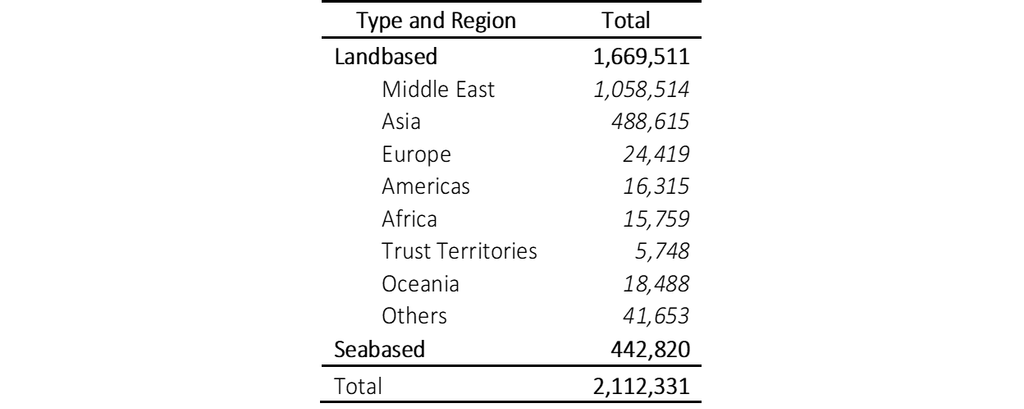
Since the establishment of the labor export framework in 1975, Filipino migration has been described by the government as a temporary strategy for national development (Asis, 2006; IOM & SMC, 2013).1 Forty years into the policy, the “temporary” measure is still in place and migration shows no sign of letting up. In 2016, there were 2.1 million Filipinos (Table 1) who left the country to work in more than 200 territories (POEA, 2016). It was the first time the Philippines breached the second million mark of outmigration, showing a 15% increase from the previous year. Currently, an estimated 10% of the Filipino population – or roughly10.2 million – are living overseas (CFO, 2016).
Despite the political narrative that it is “temporary”, remittances from the migrants has grown over the years and have become an important pillar of Philippine development. This interplay of government policies and remittance contribution to the gross domestic product (GDP) has created an indispensable role of migration and remittances to Filipino economy and politics. This paper argues that decades of migration has bred reliance on the remittances, creating a vicious cycle that would be difficult to break. However, the recent COVID-19 outbreak exposes the vulnerabilities of the otherwise resilient overseas Filipino worker and the money they send home.
This paper uses an international political economy lens to examine what has been dubbed as the Filipino ‘diaspora’. As literature suggests, migration necessarily involves international politics and economy (Johnson, 2017). The phenomenon, at least for the regular migration, is a function an international labor market which deals with on oversupply of labor in developing countries, and a demand of talent in developed ones. States have borders and regulations prompting international cooperation, and domestic groups put pressure on governments to look after the welfare of migrant workers. All of which are dynamics present in the Philippine case. While a discussion on migration is warranted, this paper zeroes in on the remittance aspect.
The first section outlines who are the overseas Filipinos and deals with the distinction between permanent, temporary, and irregular workers. The second section details the political and economic forces in history that laid down the foundations of migration streams and the current of state-market dynamics that highlights the importance of remittances to the economy. Finally, an evidence-based examination on the impact of COVID-19 on the migrants and remittances wraps up the paper.
Table 1. OFW Deployment by Region, 2016
Note: Regions as classified by Philippine Overseas Employment Authority
Source: POEA, 2016
The Overseas Filipinos: Permanent, Temporary, and Irregular
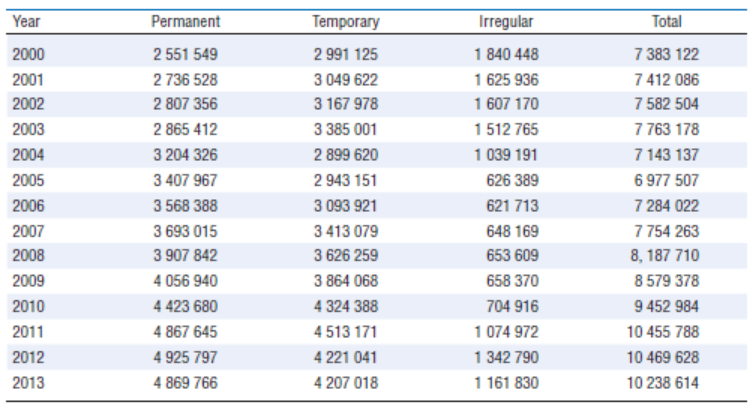
In 2016, the Philippine government created a framework to develop a comprehensive understanding of the number of migrant Filipinos in the world (CFO, 2016). The interagency committee categorized migrants into three classifications depending on their status. The first are the permanent migrants, or Filipinos who have become citizens of the destination country through naturalization or have acquired legal permanent residency. Second are the temporary migrants, or the overseas Filipino workers (OFWs), who are sea-based or land-based Filipino workers with contracts of more than six months. Finally, there are the irregular or illegal migrants who are Filipinos without a valid residence or work permits. The framework clarified a common misconception in Philippine migration: not all Filipinos abroad are OFWs. The identification is important as different types of migrants need different kinds of regulation and welfare protection. In addition, it is important to remember that all types of migrants contribute to sending remittances back to the Philippines. Table 2 below details the most recent data on estimates of permanent, temporary, and irregular migrants.2
Table 2. Stock Estimates of Overseas Filipinos, 2000-2013
Source: Commission of Filipino Overseas as cited by OECD, 2017
A Brief History of Philippine Migration
While the modern-day version of OFWs can be traced back to the 1970s, migration in the Philippines has deep colonial roots (Asis, 2017; Gonzalez, 1998). Throughout history, movement of Filipinos across borders has responded to external and internal forces of politics and economics. The first Filipino migrant workers were shipbuilders and crew members aboard the Spanish Galleon trade which was established from 1565-1898. Due to harsh working conditions, some of Filipinos would escape their contracts and would literally ‘jump ship’ at port of calls in Acapulco, Mexico and Louisiana, United States (Gonzalez, 1998). The trend of settling in abroad continued during the American colonization. By 1906, Hawaii needed workers in sugarcane and pineapple plantation and filled the need by bringing in Filipino laborers. Until 1930s, it was estimated that between 120,000 to 150,000 Filipino migrants moved to the U.S., majority of which were in pacific island (Asis, 2017).3 Post-World War II even offered more opportunities for Filipinos to migrate (Gonzalez, 1998). Those who served the U.S. Armed Forces were given special citizenship opportunities, and many moved to the U.S. pursuing second careers in medical, accounting, engineering, and other technical professions. The veterans petitioned for their family members to move to America.
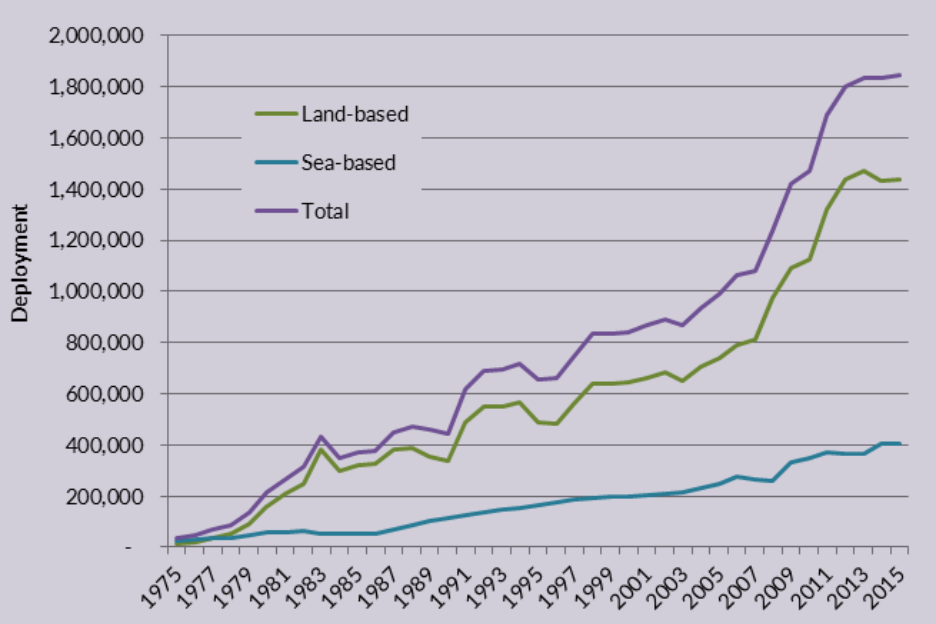
Figure 1. Deployment of Overseas Filipino Workers, 1975-2015
Source: Adapted from Asis, 2017
It was in the 1970s however that the modern-day version of OFWs started. A confluence of political and economic factors led to a conducive environment for Filipinos to leave the country. Politically, then-President Ferdinand Marcos declared Martial Law in 1972 forcing opponents to escape prosecution by going into exile. On the economic front, the Philippines was experiencing an economic downturn, with high unemployment and struggling to provide decent wages (Asis, 2017; OECD, 2017). It coincided with the easing of immigration restrictions in settlement countries and a heavy demand of workers from the oil-rich Gulf region (OECD, 2017). The Marcos administration saw this an opportunity to meet international labor demand with local oversupply. The policy made sense economically as it would stabilize the Philippine economy and reinfuse the dwindling foreign reserves (IOM and SMC, 2013). Thus, the Philippine government included a provision in the 1974 Labor Code of the Philippines to establish a framework for overseas employment program. Not long after, the government created bureaucracies specifically catered to needs of migrant workers. The Overseas Workers Welfare Administration was established in 1977 to look after the rights and interests of migrants, and the Philippine Overseas Employment Agency was created in 1982 to monitor and supervise the recruitment and placement of Filipino workers abroad. From an estimated 36,000 workers in 1975, there are 2.1 million workers deployed in 2016 as earlier previewed. Figure 1 tracks the four decades of the rapid rise of migrant worker deployment from 1975 to 2015.
Of Migration and Remittances: The Interaction of Politics and Economics
As earlier previewed, the overseas employment program of the Philippine government has been originally crafted to be a temporary strategy. In fact, even 20 years since the start of the policy, the 1995 Migrant Workers and Overseas Filipinos Act of 1995 included a provision that the “state does not promote overseas employment as a means to sustain economic growth and achieve national development” (Section 2). However, the increasing role of migration to national development cannot be ignored by policymakers. Analysts have argued that the Philippines shifted its from just protecting the welfare and regulating the recruitment process of OFWs, to being a “broker state” where it actively markets labor to other countries (Rodriguez, 2010). The Medium-Term Philippine National Development Plan of 2004 was the first government document to specifically include a national target of deploying 1 million OFWs per year. By 2006, the Philippines was able to achieve that target.
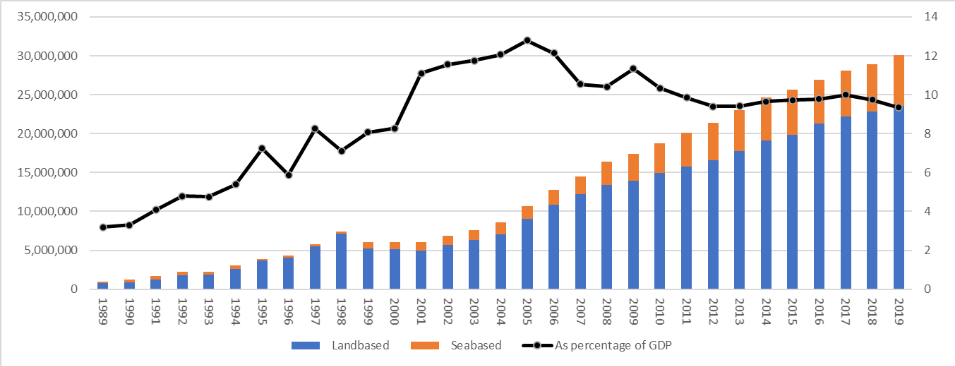
The most crucial aspect of the migration in national development is the role of remittances in the Philippine economy. In 2019, remittance reached a record high of $30.1 billion which is equivalent to about 9.3% of the gross domestic product (BSP, 2020a). This is important as the Philippines is a consumption driven economy, with households spending accounting for 62.3% of the GDP (PSA, 2020a). When overseas Filipinos send money home, it goes into basic needs such as education, food, and health (BSP Consumer Survey, 2016). Around 12% of the Philippine Households are considered OFW-dependent (PSA, 2020b). In addition, remittance is almost four times as large as foreign direct investments in the country. Total FDI inflows based on the records of the Philippine Central Bank is only at $7.6 billion in 2019 (BSP, 2020b). This growing contribution to GDP makes remittances an indispensable part of the Philippine economy. Figure 2 shows the steady increase in the amount of remittances to the Philippines, and its contribution as percentage of the GDP.
Figure 2. OFW Remittances, Sea-based and Land-based, and as Percent of GDP, 1989-2019
Source: Bangko Sentral ng Pilipinas, World Bank
The importance of remittances to the Philippine economy is not lost on the politicians and the domestic interest groups are eager to remind them. When Filipino migrants are at risk in a foreign land, domestic interest groups to put pressure on the government to take actions, which impacts the Philippines and its relationship with the destination country. One of the most famous cases was the kidnapping of OFW Angelo Dela Cruz in Iraq during the War of Terror in 2004. Facing domestic pressure, then-President Arroyo decided to pull the Philippine troops out of Iraq in exchange for the release of Dela Cruz – a move that was an important step to her political survival (Eadie, 2011). While the Philippine government was successful in getting Dela Cruz back to the Philippine safely, Arroyo was heavily criticized by the U.S. and the Coalition of the Willing alliance, affecting Philippine foreign relations (Eadie, 2011). In any case, the Philippine government has identified the protection of rights and welfare of overseas Filipinos as one of the pillars of foreign policy.4
In addition, the overseas Filipino vote is becoming an important player in election. As of 2019, around 1.8 million overseas Filipinos are eligible to vote. While this might not be a significant number in the grand scheme of things5, the effect of the overseas Filipino vote is not solely on the direct vote. According to Cook and Salazar (2016), the role of overseas Filipinos as financial providers “put them in an influential position in shaping their families’ and their immediate social networks’ voting choices” (p. 7). And given that 12% of the population is dependent on the remittance of an OFW, this is a significant part of the electorate especially when the race is tight.6
COVID-19 Tests Health of Philippine Remittance
As discussed, the 40 years of migration and remittances has formed a crucial part of the fabric of politics and economics of the Philippines. Over the years, it has exhibited resilience that has allowed it to prosper and increase its influence on both market and economies. However, the COVID-19 pandemic is different story all together. Given the structural characteristics of Philippine migration, the global health crisis has exposed the vulnerability of the Philippines to its increasing reliance on remittances.
According to the World Bank (2020a), this year will the sharpest decline of global remittances in recent history after it reached a record high $554 billion in 2019. In the Bank’s latest Migration and Development report, the economic crisis in host economies will cause a 20% decline in remittances, which in turn puts into jeopardy financial lifelines of households in developing countries. A 13% decline in East Asia is expected owing to the slowdown in inflows from the U.S., the largest source for the region. The World Bank adds that the global trend will be able to recover and grow again only in 2021.
Given the diversified nature and the wide reach of Philippine migrants, remittance to the Philippines have exhibited resilience despite some external shocks in various parts of the world. During the global financial crisis for example, the growth rate of remittances slowed down but it did not dip at a rate that it is projected to decrease this year. Between 2008 and 2009, total remittances increased by 5.6% (Figure 2). Steadily, remittances have grown year-on-year over from 2009 to 2019, with an annual average growth rate of 5.7%.
COVID-19 however is expected to decrease global GDP by 5.2% (World Bank, 2020b). This has led to unemployment in destination countries, prompting OFWs to take pay cuts or be laid off (Ang & Opiniano, 2020). Based on estimates from one of the top universities in the Philippines, the global health crisis expected to impact between 300,000 to 400,000 OFWs (And & Opiniano, 2020). As of October, the Philippine Department of Foreign Affairs has repatriated 204,481 (Marquez, 2020).
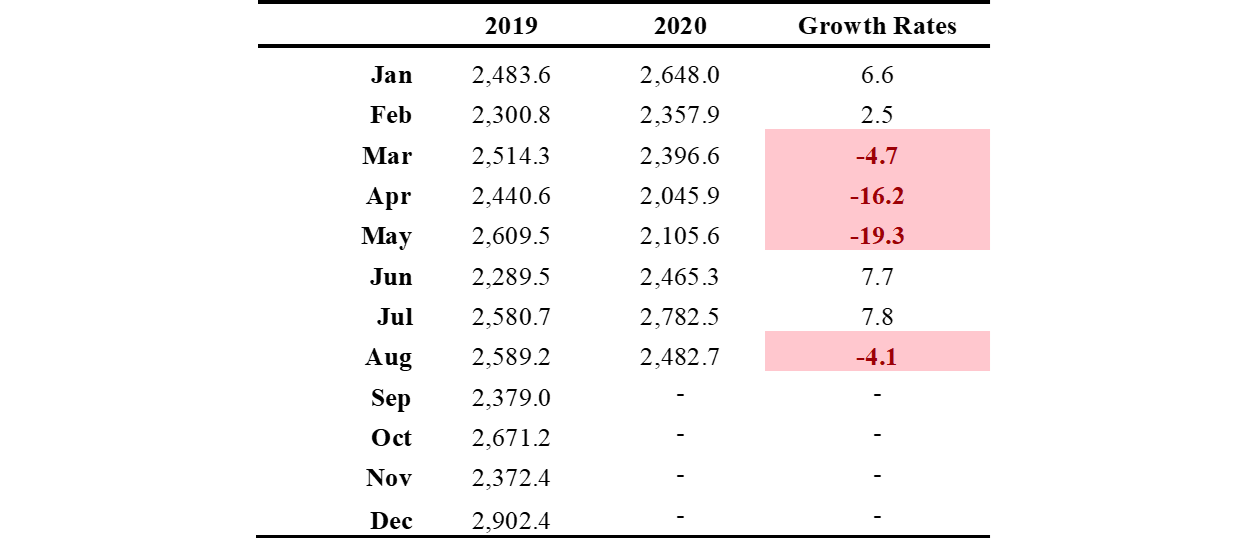
Table 3. Preliminary Data on Philippine Remittances, 2019 and 2020
Source: Bangko Sentral ng Pilipinas, 2020a
Monthly data on remittances also shows the adverse impact of the COVID-19 crisis. The 19.3% contraction in May is the lowest recorded month-on-month growth rate since 2001 (Table 3). Though there is a slight bounce back in the months of June and July, analysts argue that these are saved up funds that were not sent in the first 3 months of the pandemic as OFWs also faced strict limitations their movements (Lucas, 2020a). The remittance growth rate was negative again in August. Ang and Opiniano (2020) projects that overall, remittances this year will be 10% to 20% lower compared to last year. The Philippine Central Bank however is more optimistic than other projections. The Central Bank allayed fears about the “doomsday” scenario of a 20% decrease will be unlikely given that the total remittances as of August 2020 is just 2.6% lower compared to the inflows from the same period last year (Lucas, 2020b). Nevertheless, families dependent of OFWs remittance will experience a decrease in household spending per capita by 1-2% with expenses on food per capita also slowing down by 2-3% (Murakami et. Al., 2020).
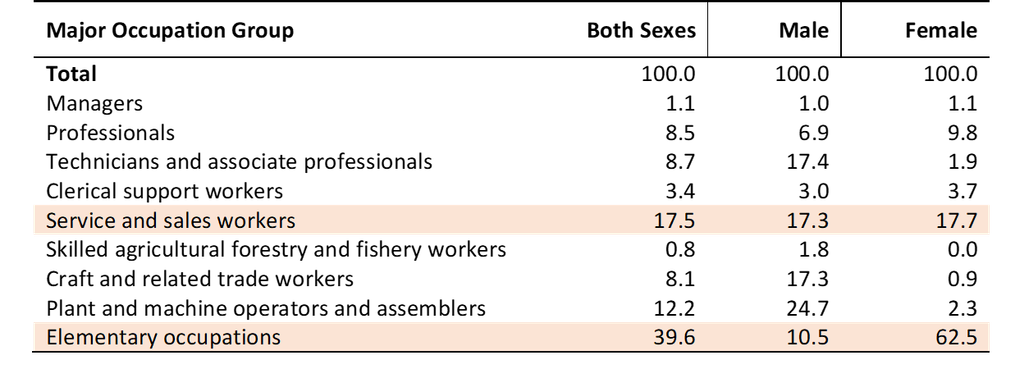
Table 4. Percentage of Male and Female Overseas Filipino Workers by Occupation: 2019
Notes: Details may not add up to totals due to rounding.
Source: Philippine Statistics Authority of the Philippines, 2019
While the Philippine Central Bank might be optimistic, the real challenge for the Philippine government is the medium- to long-term impact of the COVID-19 to migration and remittances. Remittances may keep flowing in the short-term, but the question becomes for how long? As earlier discussed, migration is a function of the international labor market’s supply and demand dynamics. While Philippines is happy to supply labor, demand may be severely affected. In its latest policy brief, the OECD (2020) noted that migrants are particularly vulnerable to the COVID-19 shock as they are employed in sectors sensitive to business fluctuations such as construction and retail services, or in industries that are heavily hit by the pandemic (hospitality and domestic services). In addition, jobs and services that may have trouble complying with physical distancing, such as grocers and cleaners, may take time to recover (OECD, 2020). It is also worth mentioning that the COVID-19 led to a slowdown in oil demand which could keep prices low until next year, and maybe even longer based on some projections (Rechtsteiner, 2020). The GCC countries, which are dependent on oil for state revenues, are experiencing their lowest levels of oil price in 17 years and could lose around $554 million a day if prices remain at $20 per barrel (Strategy&, 2020).
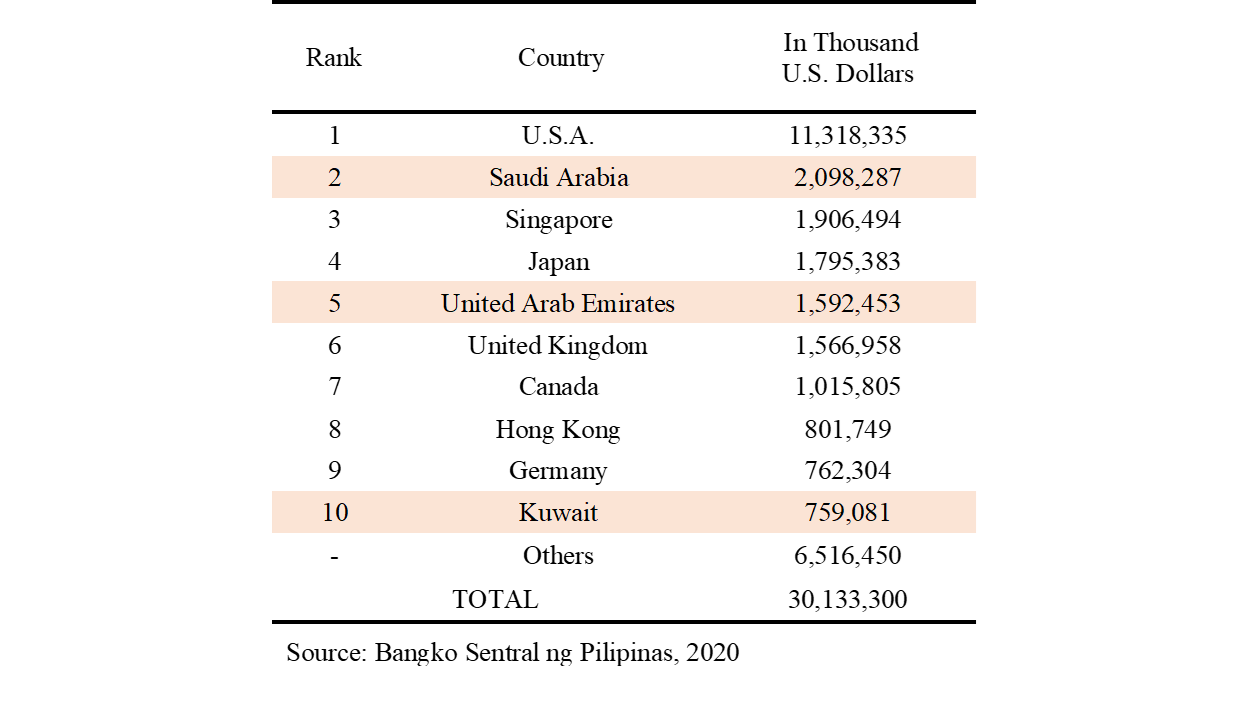
Taking both points into context, this is a cause of concern for the Philippines considering the structural characteristics of OFWs based on the latest data. More than 57% of OFWs are employed in the service and sales workers7 and elementary occupations8 (Table 4), which the OECD identifies as the vulnerable sectors. In addition, GCC countries are the destination of over 50% of the OFWs based on the latest data (2016) which could also be affected if oil demand in these economies continue to be low (Table 1). On the remittance front, 3 of the top 10 sources of remittances in 2019 are GCC economies (Table 5). Given the conditions, COVID-19 will test the 40-year resilience of Philippine remittances.
Table 5. Philippine Remittances by Source Economies, 2019
Despite the bleak outlook of the world economy and its possible impact to Philippine migration, the COVID-19 also presents an opportunity for the Philippine government to fulfill their promises to migrant workers. The government notes that migration is only an option, and not a necessity for the Filipino family. COVID-19 has abruptly sent thousands of OFWs home. The greatest challenge is reintegrating them into the domestic economy and prove that indeed migration is a “temporary” strategy all along.
References
Ang, A. &. (2020). Possible Economic Impacts of Falling Oil Prices, the Pandemic, and the Looming Global Recession onto Overseas Filipinos and their Remittances. Quezon City: Ateneo Center for Economic Research and Development. Retrieved from http://ateneo.edu/sites/default/files/downloadable-files/ADMU-WP-2020-05_0.pdf
Asis, M. M. (2006). The Philippines’ Culture of Migration. Retrieved from Migration Policy Institute: https://www.migrationpolicy.org/article/philippines-culture-migration
Asis, M. M. (2017). Philippine Labour Migration: Critical Dimensions of Public Policy. Retrieved October 21, 2020, from Migration Policy Institute: https://www.migrationpolicy.org/article/philippines-beyond-labor-migration-toward-development-and-possibly-return
Bangko Sentral ng Pilipinas. (2016). BSP Consumer Survey 2016. Philippines.
Bangko Sentral ng Pilipinas. (2020a). Overseas’ Filipino Remittances. BSP Statistics – External Accounts. Retrieved from https://www.bsp.gov.ph/SitePages/Statistics/External.aspx?TabId=8.
Bangko Sentral ng Pilipinas. (2020b). International Investment Position. BSP Statistics – External Accounts. Retrieved from https://www.bsp.gov.ph/SitePages/Statistics/External.aspx?TabId=1
Commission of Filipino Overseas (CFO). (2016). Stock Estimates of Overseas Filipinos. Retrieved October 31, 2020, from Commission of Filipino Overseas: https://cfo.gov.ph/yearly-stock-estimation-of-overseas-filipinos/
Congress of the Philippines. (1995). Migrant Workers and Overseas Filipinos Act of 1995 (Republic Act 8042). Philippines.
Congress of the Philippines. (1991). Philippine Foreign Service Act of 1991 (Republic Act No. 7157). Philippines.
Cook, M., & Salazar, L. (2016). The differences Duterte relied upon to win. Perspective by ISEAS Yusof Ishak Institute, 34, 1-12. Retrieved from https://www.iseas.edu.sg/images/pdf/ISEAS_Perspective_2016_34.pdf
Eadie, P. (2011). Philippines Overseas Foreign Workers (OFWs): Presidential Trickery and the War on Terror. Global Society, 25:1, 29-47. DOI: 10.1080/13600826.2010.522981
Gonzalez, J. L. (1998). Philippine Labour Migration: Critical Dimensions of Public Policy. Singapore: Institute of Southeast Asian Studies.
International Organization for Migration (IOM) & Scalabrini Migration Center (SMC) . (2013). Country Migration Report: The Philippines . Makati City and Quezon City: International Organization for Migration and Scalabrini Migration Center.
Johnson, H. (2017). Immigration and International Relations. doi:10.1093/OBO/9780199756223-0204
Lucas, D. (2020a). August decline ends dollar remittance bounce as OFW job losses mount. Philippine Daily Inquirer. Retrieved from https://business.inquirer.net/309599/august-decline-ends-dollar-remittance-bounce-as-ofw-job-losses-mount
Lucas, D. (2020b). OFW remittances seen far from 2020 doomsday scenario. Philippine Daily Inquirer. Retrieved from https://business.inquirer.net/309711/ofw-remittances-seen-far-from-2020-doomsday-scenario
Marquez, C. (2020). DFA repatriated more than 200,000 OFWs during pandemic. Philippine Daily Inquirer. Retrieved from https://globalnation.inquirer.net/191403/dfa-repatriated-more-than-200k-filipinos-overseas-during-pandemic
Murakami, E., Shimizutani, S. & Yamada, E. Projection of the Effects of the COVID-19 Pandemic on the Welfare of Remittance-Dependent Households in the Philippines. EconDisCliCha (2020). https://doi.org/10.1007/s41885-020-00078-9
National Economic and Development Authority. (2004). Medium-Term Philippine Development Plan. Quezon City: NEDA.
OECD/Scalabrini Migration Center. (2017). Interrelations between Public Policies, Migration and. OECD Development Pathways. Paris: OECD Publishing. doi:http://dx.doi.org/10.1787/9789264272286-en
Organisation for Economic Co-operation and Development. (2020). Managing international migration under COVID-19. OECD. Retrieved from https://read.oecd-ilibrary.org/view/?ref=134_134314-9shbokosu5&title=Managing-international-migration-under-COVID-19
Philippine Overseas Employment Authority (POEA). (2015). Compendium of OFW Statistics. Retrieved October 31, 2020, from Philippine Overseas Employment Authority: http://www.poea.gov.ph/ofwstat/ofwstat.html
Philippine Statistics Authority. (2020a). National Accounts of the Philippines: 1st Quarter 2019 to 4th Quarter 2019. Quezon City, Philippines. Retrieved October 30, 2020, from http://www.psa.gov.ph/sites/default/files/Q4%202019%20NAP%20Publication-9ch3.pdf
Philippine Statistics Authority. (2020b). Results from 2018 National Migration Survey. Quezon City, Philippines. Retrieved October 30, 2020, from https://psa.gov.ph/content/12-percent-filipino-households-have-ofw-member-results-2018-national-migration-survey
Rechtsteiner, R. O. (2020). Oil prices could remain depressed for at least a year. Here’s why. World Economic Forum. Retrieved from https://www.weforum.org/agenda/2020/04/oil-prices-could-remain-depressed-for-at-least-a-year-heres-why/
Rodriguez, R. M. (2010). Migrants for Export: How the Philippine State Brokers Labor to the World (New Edition ed.). University of Minnesota Press. Retrieved from www.jstor.org/stable/10.5749/j.cttttb3s
Strategy&. (2020). Recovering from the dual shock of COVID-19 and the oil price drop: The GCC Way. Retrieved from https://www.strategyand.pwc.com/m1/en/covid-19-oil-price-drop-gcc.html
The World Bank. (2020a). World Bank Predicts Sharpest Decline of Remittances in Recent History. Retrieved from https://www.worldbank.org/en/news/press-release/2020/04/22/world-bank-predicts-sharpest-decline-of-remittances-in-recent-history
The World Bank. (2020b). The Global Economic Outlook During the COVID-19 Pandemic: A Changed World. Retrieved from https://www.worldbank.org/en/news/feature/2020/06/08/the-global-economic-outlook-during-the-covid-19-pandemic-a-changed-world
***
This post is a paper I submitted while I was a student at the Lee Kuan Yew School of Public Policy.